
I have spent many years in the exam room, and if there is one thing that causes a pet parent’s heart to skip a beat, it is the sound of their dog struggling to catch a breath. You know that specific, heavy silence in the house that is suddenly shattered by a rhythmic honk, a wet whistle, or a terrifyingly loud snore?
It is enough to make anyone panic. However, understanding these sounds is the first step toward helping your best friend. Today, I want to take you through the symphony of canine respiratory noises so you can breathe easier too.
If you are in a hurry, use this table to identify the abnormal respiratory sounds in your dog and its symptoms.
| Sound | Potential Cause | Urgency Level |
|---|---|---|
| Stertor (snore) | Elongated soft palate (brachycephalic airway) | Low / Monitor |
| Stridor (whistle) | Laryngeal paralysis | High / Emergency |
| Honking | Tracheal collapse | Moderate / Chronic |
| Gurgling | Pulmonary edema or pneumonia | Critical |
Before anything, we need to talk about what “normal respiration” actually looks like in a healthy dog.
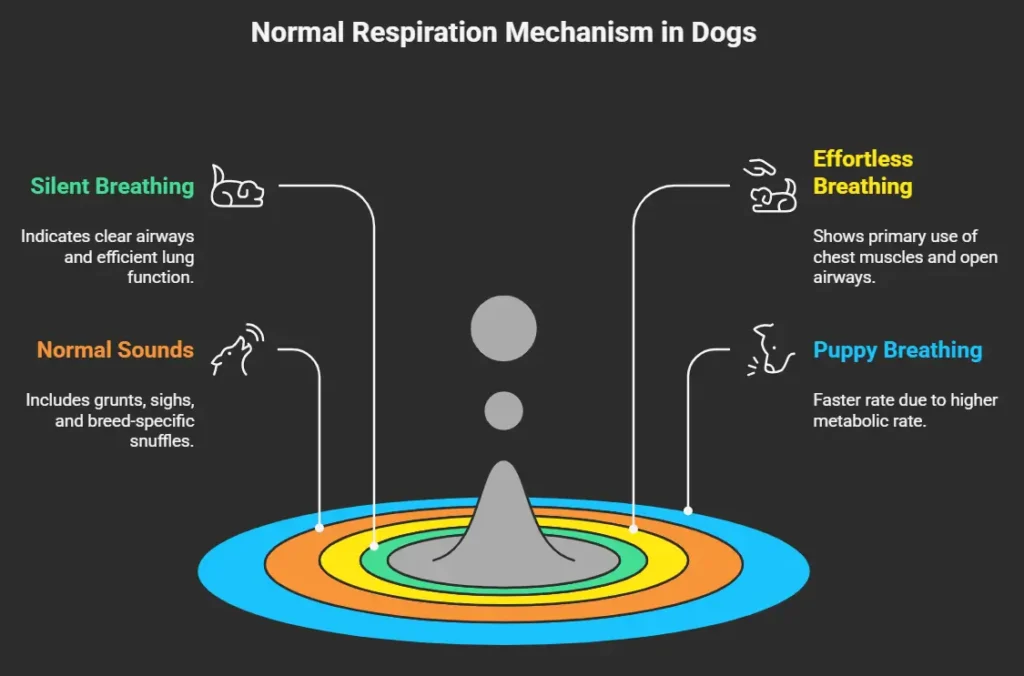
Most of the time, your dog should be a silent breather, with their chest moving rhythmically and effortlessly. If you have to stop and really look to see if they are breathing while they nap, that is actually a great sign.
It means their airway is clear, their lungs are elastic, and their heart is pumping efficiently. When we start hearing noises, it is usually because something is creating turbulence in the air as it moves in or out of the body.
The Mechanics of Healthy Breathing in Dogs
In a perfect world, air travels through the nose or mouth, down the trachea, and into the lungs without hitting a single speed bump. This process is silent because the tissues are firm and the pathways are wide open.
I always tell my clients to watch their dog’s “effort” rather than just listening for sound. A healthy dog uses their chest muscles primarily, and you should never see their stomach muscles heaving or their neck stretching out just to get a gulp of air.
Knowing this baseline helps you spot the fast breathing in dogs and even tiny changes that happen before a full-blown respiratory crisis occurs.
Identify Normal Sounds
Of course, not every sound is a reason to rush to the emergency clinic. Dogs grunt when they get comfortable, they sigh when they are bored, and some breeds have a naturally louder “snuffle” due to their facial structure.
Puppies might even have a slightly faster respiratory rate than adult dogs because their metabolic rate is higher. I want you to get familiar with your dog’s specific “resting” soundtrack.
If your Pug has snorted since the day you brought them home, that is their normal, but if your Golden Retriever suddenly starts sounding like a freight train, we have a different story on our hands.
When the noise sounds like it is coming from the head or the throat, we are usually dealing with an upper airway issue. These are often the loudest and most “dramatic” sounds a dog can make, and they can be quite distressing to hear in the middle of the night.
In the veterinary world, we categorize these primarily as stertor and stridor. While they sound similar to the untrained ear, they tell me very different things about where the obstruction is located and how we need to treat it to get your dog feeling better.
What is Stertor?
Stertor is that low-pitched, noisy breathing in dogs that sounds exactly like snoring or a very congested human.
It usually happens when there is a vibration of fluid or relaxed tissue in the back of the throat or the nasal passages. Think of it like trying to blow air through a straw that has a bit of paper fluttering at the end.
It is most common in our flat-faced friends, like Bulldogs or Boston Terriers, because they have long soft palates that dangle into the airway. If your dog sounds “nasal” or “congested” but is otherwise acting fine, stertor is likely the culprit behind the noise.
What is Stridor?
Stridor is a high-pitched, strained noise that occurs when the larynx or the upper part of the windpipe is narrowed.
I often describe it as a “whistling” sound that happens every time the dog inhales. This is frequently seen in older, large-breed dogs who might be developing a condition called laryngeal paralysis.
When those folds in the throat cannot open properly, the air has to squeeze through a tiny gap, creating that haunting, musical, but very dangerous sound that signals a struggle for oxygen.
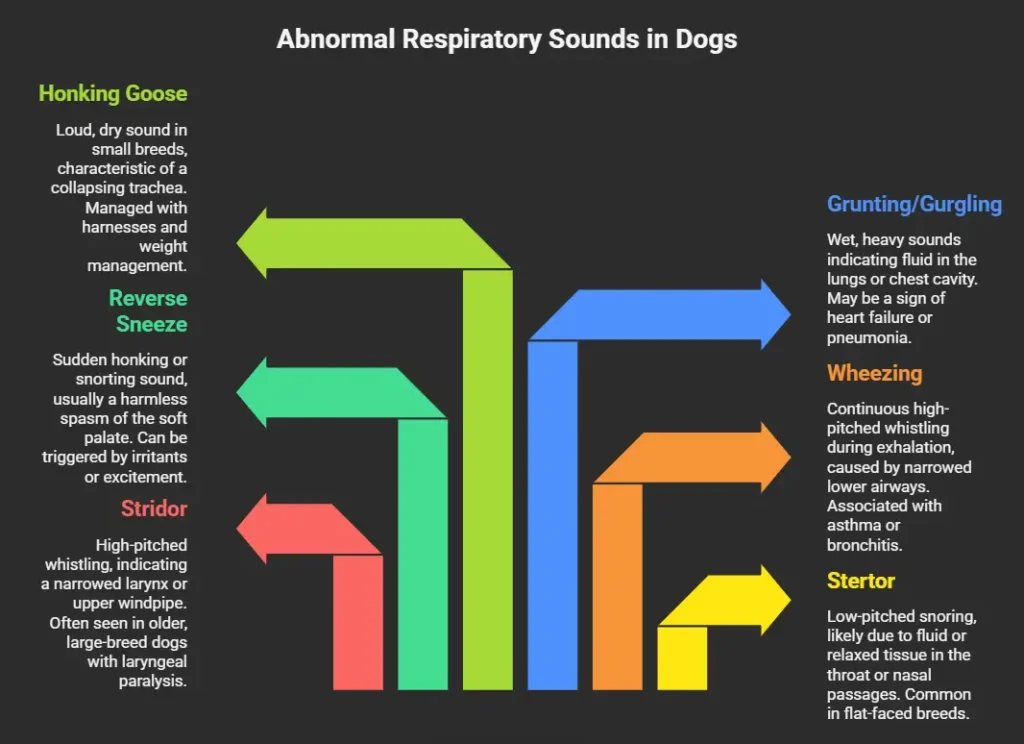
Wheezing in dogs is a continuous, high-pitched whistling sound caused by air traveling through narrowed or constricted lower airways. It typically occurs during exhalation and indicates underlying inflammation, mucus, or spasms within the bronchi, often requiring a professional veterinary evaluation.
As we move further down the respiratory tract, the sounds change from snores and whistles to something more musical and rhythmic.
Wheezing is a term people use a lot, but in a clinical setting, it has a very specific meaning regarding the small tubes inside the lungs. When air is forced through narrowed or constricted bronchi, it creates a high-pitched whistling sound that is often more audible when the dog is exhaling.
This is the body’s way of telling us that the deep “pipes” are constricted, often due to inflammation or allergic reactions.
The Causes of Canine Wheezing
Wheezing is often linked to conditions like canine asthma, though it is much rarer in dogs than in cats, or chronic bronchitis.
If your dog has been exposed to smoke, heavy perfumes, or lots of dust, their airways might go into a “spasm” to protect themselves. This constriction makes the pathway narrow, and as the dog tries to push air out, you hear that telltale wheeze.
It is important to note if the wheeze is dry or if it sounds “wet,” as a wet wheeze might suggest there is fluid or mucus sitting in those lower chambers that needs to be cleared.
Differentiating Wheezing from a Cough
It is very common for dog owners to confuse a wheeze with a “productive” cough, but they are distinct clinical signs.
A wheeze is a continuous sound during the breath, while a cough is a sudden, forceful expulsion of air meant to clear a blockage. I often see dogs who wheeze for a few minutes and then end the episode with a dry, hacking cough.
This sequence usually tells that the airways are irritated and the dog is trying to “clear the pipes.” If you notice your dog’s sides moving heavily while they wheeze, they are likely working much harder than they should have to.
A reverse sneeze looks like the dog is choking or having a seizure because they extend their neck, their eyes bulge slightly, and they make a terrifying “snorting” or “honking” sound.
I cannot tell you how many panicked phone calls I get about reverse sneezing, and I honestly love being the one to tell owners it is usually nothing to worry about. But, in reality, it is just a spasm of the soft palate. It is the body’s way of trying to get an irritant out of the back of the throat rather than out of the nose.
Why Do Dogs Reverse Sneeze?
Most of the time, a reverse sneeze is triggered by something simple like a blade of grass, a bit of pollen, or even just getting too excited during a game of fetch.
Some dogs do it when they pull too hard against a collar, which puts pressure on their throat. While it looks like they cannot breathe, they are actually getting plenty of air through their nose.
I usually tell my clients to gently rub their dog’s throat or briefly cover their nostrils to encourage them to swallow, which usually resets the palate and stops the “attack” almost instantly.
When Reverse Sneezing Becomes a Problem?
While the occasional episode is normal, if your dog starts reverse sneezing 10 times a day, we need to look closer.
Frequent episodes can be a sign of nasal mites, a foreign body stuck in the nasopharynx, or even nasal tumors in older dogs. If the episodes are getting longer, more frequent, or are accompanied by a bloody nose or a change in the shape of the bridge of their nose, then it is time to stop thinking of it as a “quirky” habit and start treating it as a clinical symptom that requires a thorough diagnostic workup.
Sometimes the sounds are not sharp or musical, but rather “heavy” and “wet.” When I hear a dog gurgling, my veterinarian brain immediately goes to the possibility of fluid in the lungs or the chest cavity.
It is a very different sound than the dry snort of a reverse sneeze. It sounds like someone blowing bubbles through a straw into a glass of water. And it is a major red flag that the heart or the lungs are not functioning correctly, and it usually requires oxygen therapy and diuretics to manage effectively.
Pulmonary Edema and Heart Failure
In many older dogs, especially those with known heart murmurs, a wet, gurgling sound is a sign of congestive heart failure.
When the heart cannot pump blood efficiently, pressure builds up in the vessels of the lungs, and fluid begins to leak into the air sacs. It makes it incredibly difficult for the dog to exchange oxygen.
If you hear a “wet” sound and notice your dog is restless, cannot get comfortable, or has a purple or blue tint to their tongue, you are looking at a true medical emergency that cannot wait until the morning.
Pneumonia and Secondary Infections
Not all gurgling is heart-related; sometimes it is a sign of a deep infection like pneumonia or other bacterial infections in dogs. This is common in dogs who have recently had “kennel cough” or who have accidentally inhaled food or water, which we call aspiration pneumonia.
These dogs usually have a fever, are very lethargic, and their breathing sounds “thick” and “heavy.” I always check for a “moist” cough in these cases, as the dog will often try to hack up the infection-laden fluid.
Early intervention with antibiotics and nebulization can make a world of difference in these cases.
If you own a small breed dog like a Yorkie, Pomeranian, or Chihuahua, you might be familiar with the “goose honk.”
It is a very specific, loud, dry sound that happens when a dog gets excited or pulls on their leash. It is the hallmark sign of a collapsing trachea. The trachea is held open by rings of cartilage, but in some dogs, these rings are weak and begin to flatten out over time.
When the dog breathes quickly, the tube flattens, and the air rushing through the narrow gap creates that unmistakable “honk.”
Managing the Honk at Home
Tracheal collapse is a chronic condition, but we can manage it quite well if we catch it early. The first thing I tell my clients is to ditch the neck collar and switch to a well-fitted harness. Any pressure on the windpipe is going to trigger a coughing fit and make the condition worse over time.
Weight management is also huge here; an overweight dog has extra fat pressing on their airway, making it even harder for those weak cartilage rings to stay open. Keeping your dog “lean and mean” is the best medicine for a collapsing trachea.
Medical Interventions for Tracheal Issues
When lifestyle changes aren’t enough, we turn to medications like cough suppressants or bronchodilators to keep the dog comfortable.
In very severe cases where the dog is literally “honking” with every breath and turning blue, we can even talk about surgical options like placing a stent inside the trachea to prop it open.
This is a specialized procedure, but for the right dog, it can be a total lifesaver.
I want every pet owner to have a “mental checklist” for when an abnormal respiratory sound in dogs moves from “keep an eye on it” to “get in the car right now.”
While most respiratory sounds can wait for a scheduled appointment, there are specific signs of respiratory distress that are non-negotiable emergencies. Dogs are incredibly stoic, and by the time they are showing outward signs of being unable to breathe, they are often much further along in their illness than we realize.
Trust your gut; if you feel like they are struggling, they probably are.
Color Changes and Gum Health
The easiest way to check your dog’s oxygen level at home is to look at their gums and tongue.
In a healthy dog, they should be a nice, bubblegum pink. If they look pale, white, grey, or especially blue or purple, your dog is in a state of hypoxia, meaning they aren’t getting enough oxygen to their tissues.
This is a “red alert” situation. If you press your finger on the gum, the color should return within two seconds. If it takes longer, their circulation is compromised, and they need professional help immediately.
Posture and Effort
Watch how your dog is standing. A dog in respiratory distress will often stand with their elbows flared out and their neck extended in what we call an “orthopneic position.” They are trying to make their airway as straight as possible to get air in.
They may also be using their abdominal muscles to “push” air out, which looks like their belly is pumping in and out with every breath. If your dog refuses to lie down or seems terrified to close their eyes because they are focusing so hard on breathing, please do not wait. Get them to a vet.
Understanding the difference between a simple reverse sneeze and a life-threatening stridor can be the difference between a quiet night at home and a frantic trip to the ER. As a veterinarian, my goal is always to empower you with the knowledge to know what you are hearing.
Remember that while many of these sounds are common, none of them should be ignored if they represent a change in your dog’s normal behavior. If you are ever in doubt, record a short video of the sound on your phone to show your vet. It is the single most helpful tool you can bring to an exam.
