
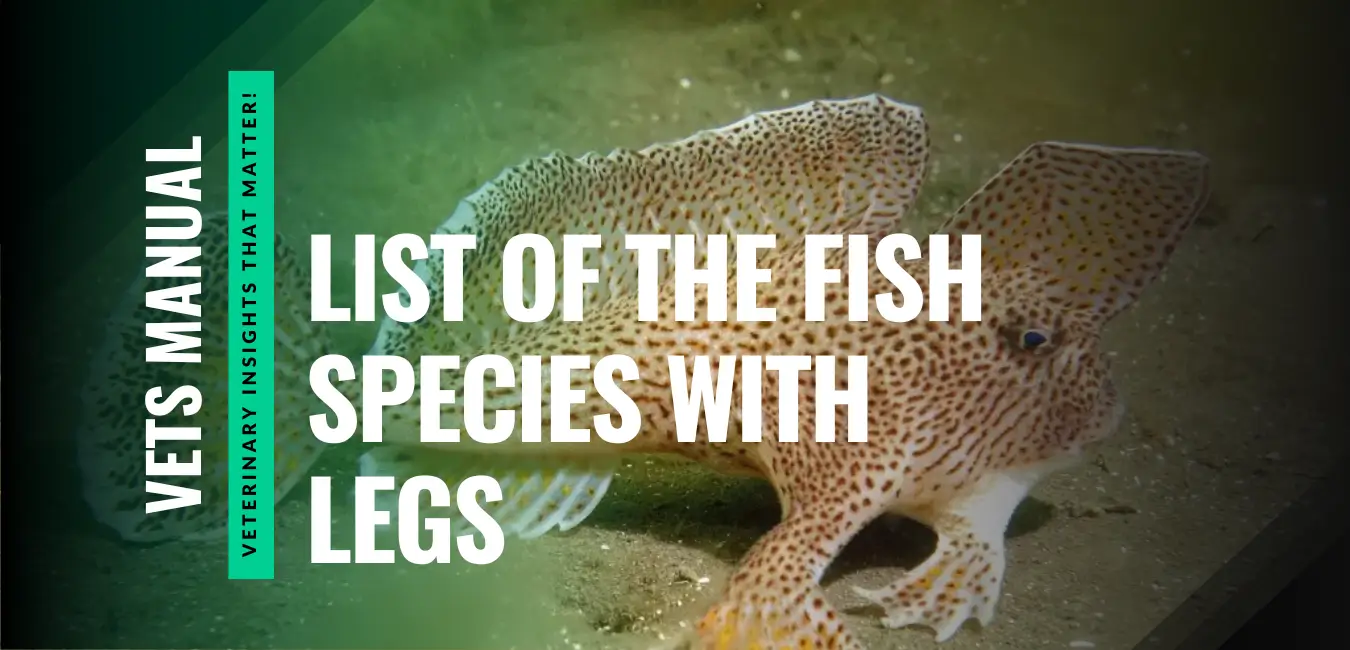
| # | Species | Primary “Walking” Mechanism | Habitat Type | Key Evolutionary/Biological Feature |
|---|---|---|---|---|
| 1 | Axolotl | 4 Functional Limbs | Freshwater Lakes | Neotenic; retains larval gills |
| 2 | Mudskipper | Pectoral Fin “Skipping” | Mangrove/Mudflats | Can breathe through skin and mouth |
| 3 | Walking Catfish | Stiff Pectoral Spines | Ponds/Rivers | Uses “serpentine” motion on land |
| 4 | Frogfish | Jointed Fin “Galloping” | Coral Reefs | Master of camouflage and mimicry |
| 5 | Seahorse | Prehensile Tail Climbing | Seagrass/Reefs | Lacks scales; uses bony plates |
| 6 | Loach | Suction-Cup Pectoral Fins | Fast Rivers | “Crawls” against strong currents |
| 7 | Batfish | Tripod-like Fin Marching | Deep Sea Floor | Flattened body for high-pressure depth |
| 8 | Handfish | Hand-like Pectoral Fins | Seafloor (Tasmania) | Prefers “walking” on palms over swimming |
| 9 | Lungfish | Bony Lobe Fins | Swamps/Mud | Possesses lungs; can live in dried mud |
| 10 | Epaulette Shark | Muscular Fin Crawling | Tidal Pools | Hypoxia-tolerant; walks between pools |
| 11 | Tiktaalik | Primitive Wrist Joints | Ancient Swamps | The “Missing Link” fossil to land animals |
| 12 | Sea Robin | Sensory Leg Rays | Sandy Ocean Floor | Legs can “taste” buried prey (2024 Study) |
| 13 | Red-Lipped Batfish | Modified Pectoral/Pelvic Fins | Galapagos Reefs | Sits like a tripod; features red “lips” |
| 14 | Coelacanth | Lobed “Horse-Trot” Fins | Deep Sea Caves | Living fossil with human-like bone structure |
| 15 | Climbing Perch | Spiny Gill Plate Crawling | Stagnant Waters | Can travel between ponds over land |
The first thought that came to our mind after listening to the word Fish is swimming. Generally, this species has fins that can help it navigate through the water. Surprisingly, there are some fish that are considered to possess legs. Now, I will let you look into the facts of fish with legs.
Research has shown that these legs are actually the fins, which are modified into a structure resembling a leg-like structure. Hence, they have aroused curiosity among people. This brilliant feature has confirmed the presence of unique organisms and the incredible diversity of life on Earth.
Fish walk by using modified, muscular pectoral and pelvic fins as structural limbs to push, pivot, or crawl across the seafloor and land.
This unique locomotion is powered by specialized skeletal joints and nervous systems that mimic the coordinated movements of four-legged land animals. While humans use bones, muscles, and joints to walk, fish have adapted their anatomy in three distinct ways to navigate their environments.
Understanding these “walking” styles explains how life eventually moved from the oceans to the land.
1. Modified Fin Rays (The “Tasters”)
Some species, like the Sea Robin, don’t use their whole fin to walk. Instead, the lower rays of their pectoral fins have detached and evolved into flexible, finger-like appendages.
These “legs” are not just for movement; according to 2024 Harvard research, they are packed with sensory papillae that allow the fish to “taste” and “smell” prey buried under the sand.
2. Muscular Lobe Fins (The “Stump-Walkers”)
Species like the Lungfish and the ancient Tiktaalik possess “lobe fins.” Unlike the thin, fan-like fins of a goldfish, these fins have a central stalk of bone and muscle. This skeletal structure is the direct ancestor of the human arm and leg.
It provides the leverage needed to “heave” a heavy body through thick mud or shallow swamps.
3. Fin-Tip Galloping (The “Crawlers”)
The Frogfish and Handfish use their pectoral and pelvic fins as actual feet. They move with a “crutching” motion, where they plant their fins on the seafloor and pull their bodies forward.
This is often described as a “slow-motion gallop,” which allows them to sneak up on prey without creating the vibrations that swimming would cause.
Have you really seen any fish with legs? Well, I didn’t even know about them before coming across this fascinating fact. And now, I am able to create this list of the 15 species of fish with legs along with their unique features, habitat, and behavior.
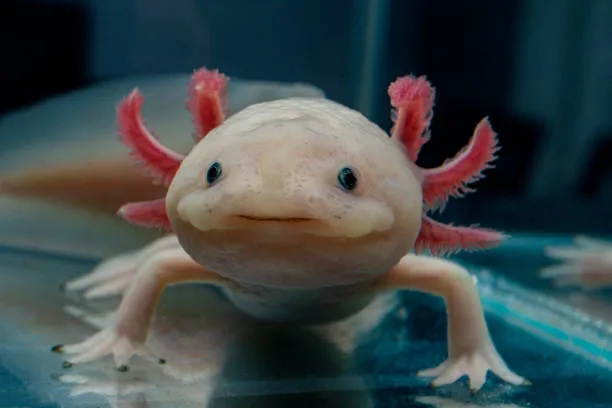
1. Axolotl (The Mexican Walking Fish)
- Scientific Name: Ambystoma mexicanum
- Type: Neotenic Amphibian (Salamander)
- Habitat: Lake Xochimilco and the canals of Mexico City
- Diet: Carnivorous; feeds on small fish, worms, and mollusks
The Axolotl, commonly called “The Mexican Walking Fish,” is the most iconic member of the “fish with legs” category, though it is technically a species of salamander. Unlike other amphibians, Axolotls exhibit neoteny, meaning they retain their larval features, including external gills and a finned tail, throughout their entire lives without undergoing metamorphosis.
Their 4 limbs are fully functional for “walking” along the muddy bottoms of freshwater lakes. Beyond their appearance, they are a subject of intense veterinary research due to their extraordinary ability to regenerate not just limbs, but also heart tissue and parts of their central nervous system.
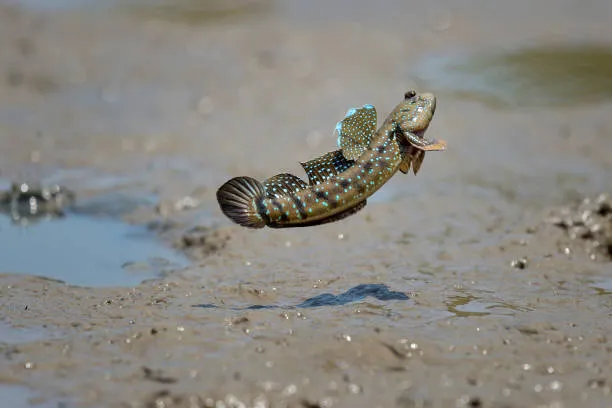
2. Mudskipper
- Scientific Name: Oxudercinae (Subfamily)
- Type: Amphibious Ray-finned Fish
- Habitat: Mangrove swamps, estuaries, and intertidal mudflats of Africa, Asia, and Australia
- Diet: Small invertebrates (crabs, insects) and algae
The Mudskipper is perhaps the most famous example of a “true fish” that spends the majority of its life on land. Unlike most fish, they have highly modified pectoral fins that function like primitive legs, and allow them to “skip” or walk across muddy surfaces with ease. To survive outside the water, they utilize a unique dual-breathing system.
They store water in enlarged gill chambers and can also absorb oxygen through their moist skin and mouth lining. This remarkable adaptation allows them to hunt and defend territories on land during low tide, which makes them a primary subject of study regarding the evolutionary transition from aquatic to terrestrial life.
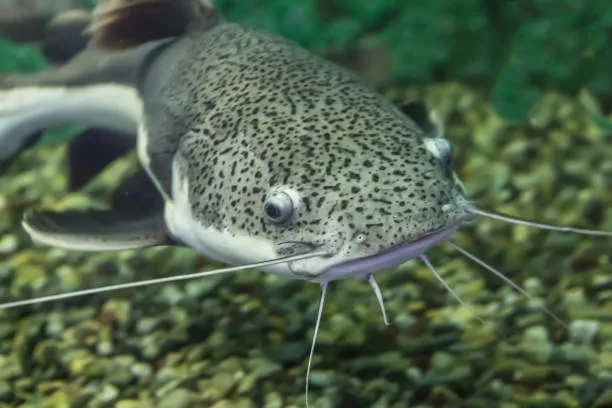
3. Walking Catfish
- Scientific Name: Clarias batrachus
- Type: Freshwater Air-breathing Fish
- Habitat: Ponds, swamps, and stagnant rice paddies in Southeast Asia (Invasive in Florida, USA)
- Diet: Opportunistic omnivore; feeds on small fish, insects, plant matter, and detritus
The Walking Catfish is renowned for its ability to navigate across land to find new water sources when its current habitat dries up. It achieves “walking” by using its stiff pectoral spines as pivots, creates a “serpentine” motion with its body to push forward. A critical anatomical feature is its suprabranchial organ, which is an accessory breathing structure that allows the fish to extract atmospheric oxygen.
This allows it to survive out of water for several hours. While native to Asia, it has become a notorious invasive species in North America, where it can be seen “walking” across roads during heavy tropical rainstorms to colonize new drainage canals.
4. Frogfish
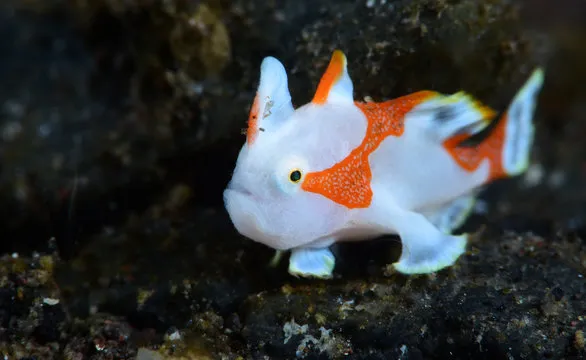
- Scientific Name: Antennariidae (Family)
- Type: Lophiiform (Anglerfish)
- Habitat: Tropical and subtropical coral reefs and rocky seafloors
- Diet: Ambush predator; consumes small fish and crustaceans
The Frogfish is a master of disguise and one of the most unusual “walkers” in the ocean. Rather than swimming, which it does quite poorly, the Frogfish uses its arm-like pectoral and pelvic fins to crawl and “gallop” along the seabed. These fins are highly modified with joint-like structures and allow the fish to maintain a steady, leg-like gait.
As a member of the Anglerfish order, it remains motionless for hours, perfectly blending into its environment through mimicry (appearing as sponges or coral). When prey approaches, it uses its illicium (a modified dorsal spine) as a fishing lure, striking with one of the fastest feeding actions in the animal kingdom.
5. Seahorse
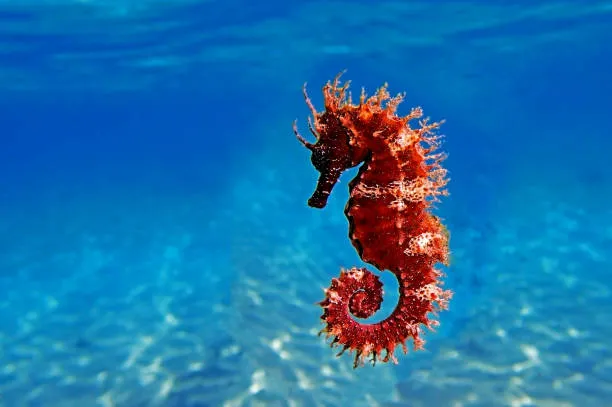
- Scientific Name: Hippocampus
- Type: Syngnathid Marine Fish
- Habitat: Shallow coastal waters, seagrass beds, and coral reefs
- Diet: Tiny crustaceans and zooplankton
The Seahorse is an outlier in this list because it lacks the limb-like fins found in other “walking” species. However, it is included due to its erect posture and unique locomotion. It uses its prehensile tail to anchor itself to vegetation, effectively “stepping” from one blade of seagrass to another.
This behavior mimics terrestrial climbing more than aquatic swimming. From a veterinary perspective, their skeleton is composed of bony plates rather than scales. It provides a rigid structure that supports their upright, horse-like movement.
6. Loach
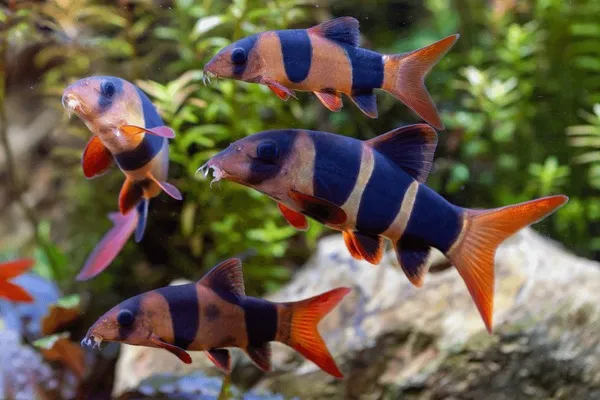
- Scientific Name: Cobitidae (Family)
- Type: Benthic Freshwater Fish
- Habitat: Fast-flowing rivers and streams across Europe and Asia
- Diet: Detritivores; feeding on invertebrates, algae, and organic debris
Loaches are specialized bottom-dwellers with elongated bodies designed for life in high-current environments. Certain species, like the Kuhli Loach and the Hillstream Loach, have developed horizontal pectoral fins that act as suction cups and stabilizers.
These fins allow them to “crawl” over slippery rocks and substrate against strong currents. Their ability to navigate the riverbed using these fins as mechanical levers makes them look as though they are walking along the river floor.
7. Batfish
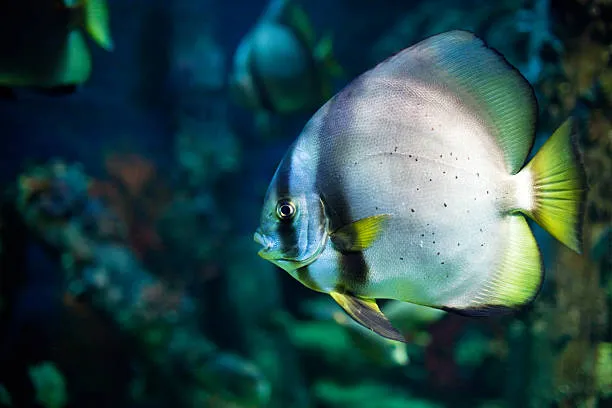
- Scientific Name: Ogcocephalidae (Family)
- Type: Benthic Lophiiform
- Habitat: Deep-sea floors ranging from continental shelves to abyssal plains
- Diet: Small fish, crustaceans, and polychaete worms
The Batfish (distinct from the Galapagos Red-Lipped variety) is a master of sedimentary locomotion. They possess a heavily depressed body shape and thick, muscular pectoral and pelvic fins.
These fins function as functional “legs,” and allow the fish to march across the sandy ocean floor in search of food. Because they are poor swimmers, they rely on this tripod-like gait to maintain stability in deep-sea currents.
8. Handfish
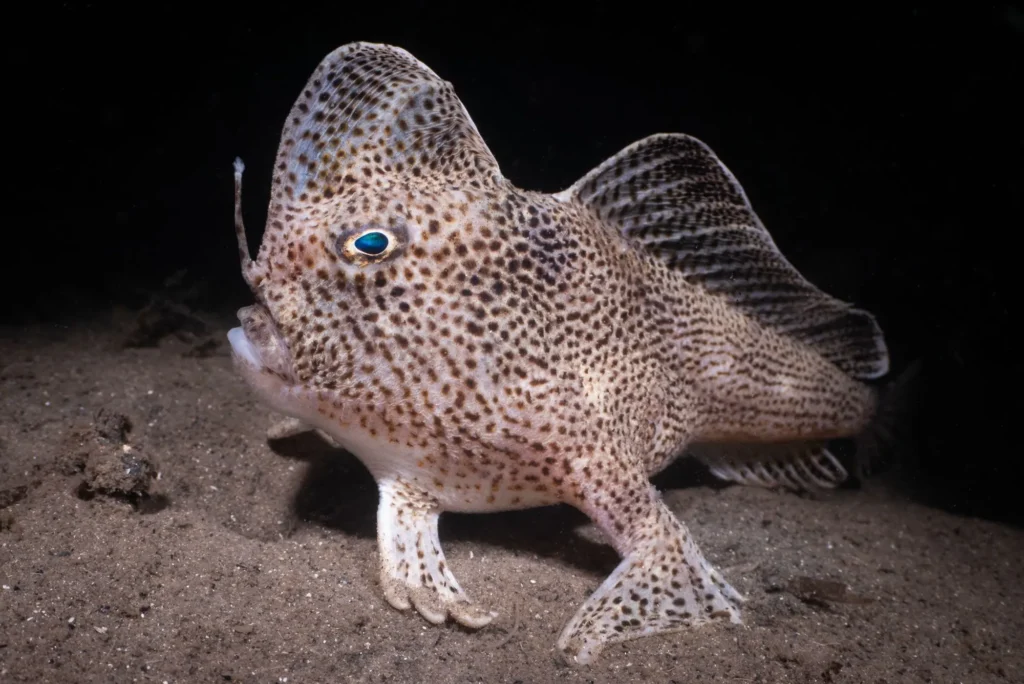
- Scientific Name: Brachionichthyidae (Family)
- Type: Anglerfish relative
- Habitat: Shallow coastal waters of Tasmania and Southern Australia
- Diet: Small crustaceans and mollusks
The Handfish is perhaps the most literal “fish with legs” in the ocean. Their pectoral fins have evolved into hand-like appendages, complete with “fingers” that they use to pull themselves along the seafloor. Unlike almost any other fish, they rarely swim.
Instead, they prefer to “walk” on their palms. Sadly, many species, such as the Spotted Handfish, are critically endangered due to habitat loss and the introduction of invasive species, making them a high priority for marine conservationists.
9. Lungfish
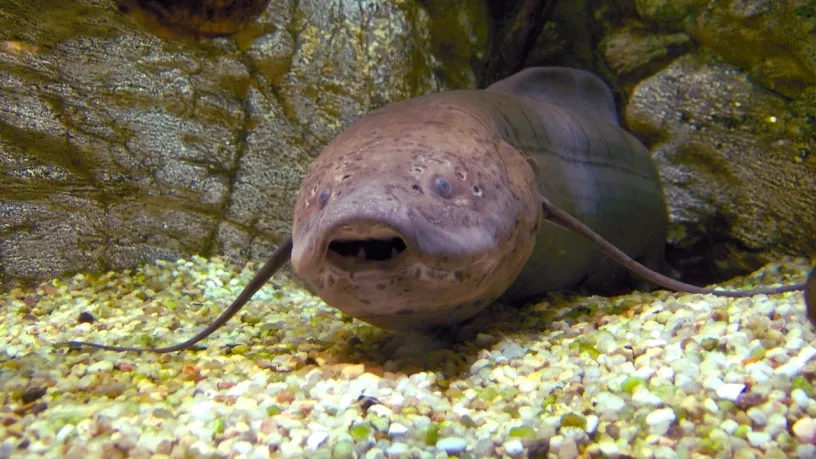
- Scientific Name: Dipnoi (Class)
- Type: Sarcopterygian (Lobe-finned fish)
- Habitat: Seasonal rivers and swamps in Africa, South America, and Australia
- Diet: Omnivorous; eating aquatic plants, mollusks, and small fish
The Lungfish is a living testament to evolutionary history. These fish possess primitive lungs, which allow them to breathe air during dry seasons. Their lobed fins are supported by a central bony axis (similar to human arm bones), which they use to “walk” through thick mud and shallow water.
During droughts, the Lungfish can undergo aestivation, which is defined as burrowing into the mud and breathing air for years until the rain returns. This makes them a vital link in understanding how vertebrates moved from water to land.
10. Epaulette Shark
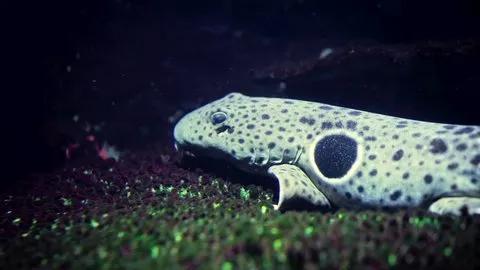
- Scientific Name: Hemiscyllium ocellatum
- Type: Orectolobiform (Carpet Shark)
- Habitat: Shallow coral reefs and tidal pools of Australia and New Guinea
- Diet: Crabs, worms, and small bony fish
The Epaulette Shark is famous for its ability to walk on land. When the tide goes out, leaving it trapped in shallow pools, this shark uses its muscular pectoral and pelvic fins to crawl over dry coral and sand to reach the next pool.
To survive this, they have evolved a hypoxia-tolerant brain, allowing them to live with very little oxygen for extended periods. This “walking” shark is a prime example of an apex predator adapting its locomotion for a semi-terrestrial environment.
11. Tiktaalik (The “Fishapod”)
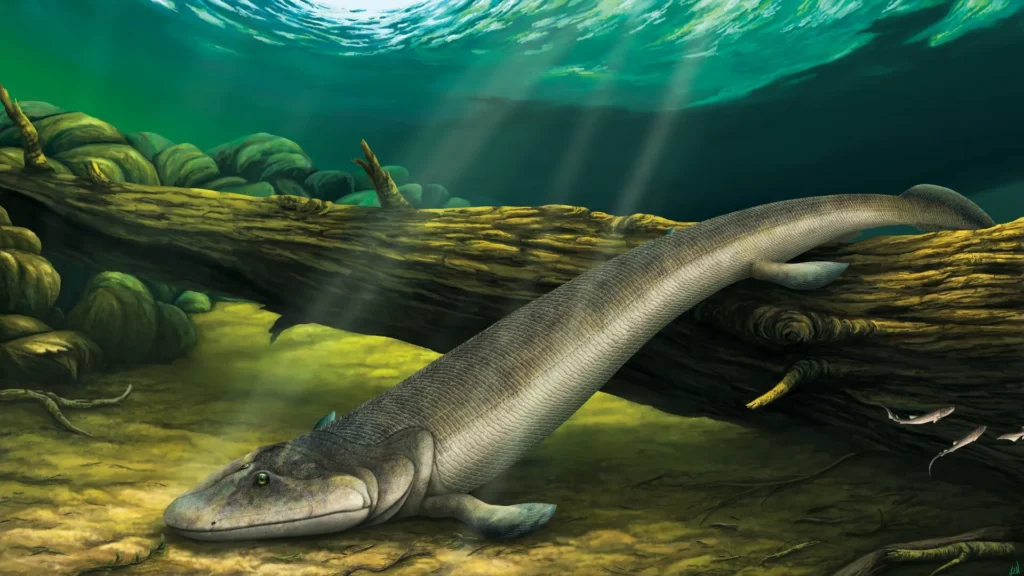
- Scientific Name: Tiktaalik roseae
- Type: Extinct Lobe-finned Fish
- Habitat: Shallow subtropical streams and swamps (Ancient Arctic Canada)
- Diet: Small fish and invertebrates
Often called the “missing link,” Tiktaalik is perhaps the most famous fish with legs in history. This 375-million-year-old fossil represents the bridge between water-dwelling fish and land-dwelling tetrapods.
It possessed scales and gills like a fish, but also a mobile neck and sturdy, limb-like fins with functional wrist joints. These “legs” allowed it to prop itself up and navigate the shallow, oxygen-poor marshes of the Devonian period, paving the way for all future land animals.
12. Sea Robin
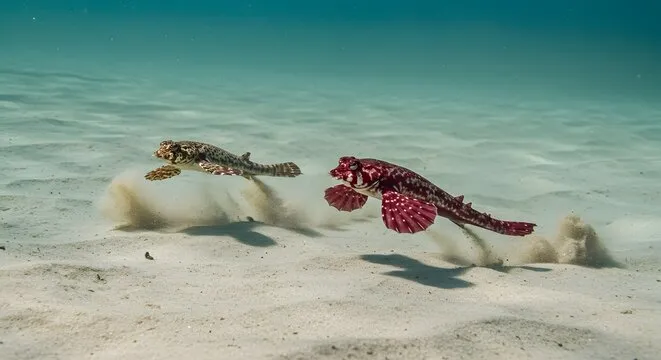
- Scientific Name: Prionotus carolinus
- Type: Bony Fish (Scorpaeniform)
- Habitat: Sandy ocean floors of the Western Atlantic
- Diet: Crabs, shrimp, and buried mollusks
The Sea Robin is a true marvel of adaptation. While it has large, wing-like pectoral fins for swimming, it also features “6 legs” modified fin rays that move independently like the legs of a crab. Recent scientific studies (late 2024) have revealed that these legs are not just for walking.
In fact, they are covered in sensory papillae, similar to human taste buds. This allows the Sea Robin to literally “taste” the seafloor as it walks, detecting hidden prey buried deep beneath the sand.
13. Red-Lipped Batfish
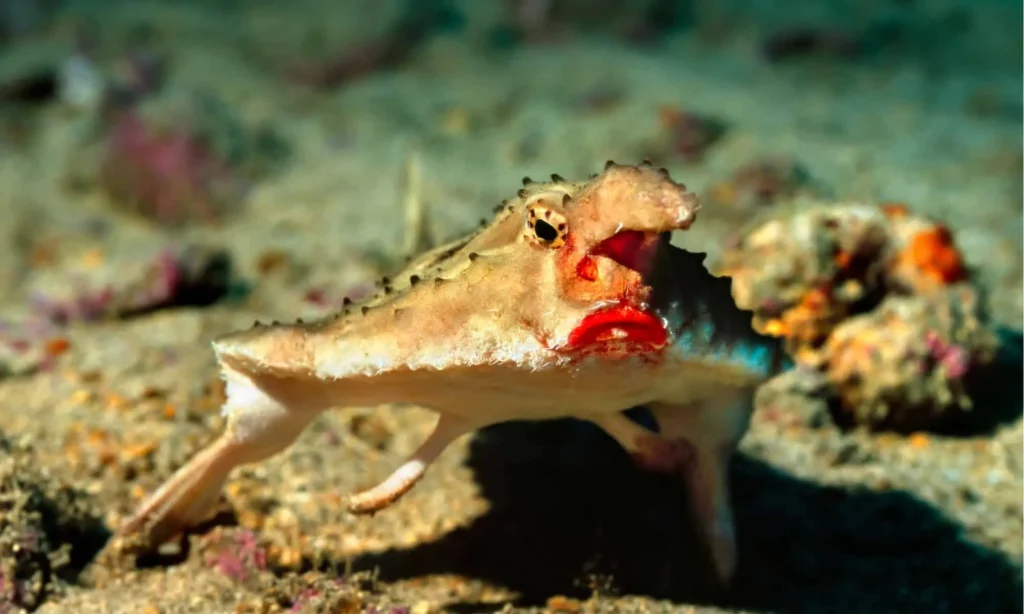
- Scientific Name: Ogcocephalus darwini
- Type: Anglerfish family
- Habitat: Sandy bottoms and coral reefs around the Galapagos Islands
- Diet: Small fish, shrimp, and mollusks
Endemic to the Galapagos Islands, the Red-Lipped Batfish is famous for its bright, fluorescent red pout and its inability to swim well. Instead of gliding through the water, it uses its highly modified pectoral, pelvic, and anal fins to “walk” along the ocean floor.
It is often seen perched on its fins like a tripod, using a specialized “lure” (illicium) on its head to attract prey toward its mouth. It is a perfect example of a fish that has almost entirely abandoned swimming in favor of walking.
14. Coelacanth
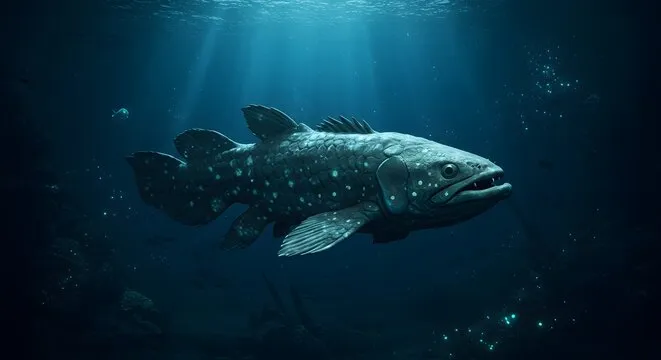
- Scientific Name: Latimeria chalumnae
- Type: Lobe-finned Fish
- Habitat: Deep-sea caves and volcanic slopes off the coasts of Africa and Indonesia
- Diet: Deep-sea fish, squids, and small sharks
The Coelacanth was thought to have gone extinct 66 million years ago until it was rediscovered in 1938. It is the ultimate “living fossil.” Unlike most modern fish, its pectoral and pelvic fins are supported by bones that are structurally similar to the limbs of land-dwelling animals.
While it doesn’t “walk” on the seafloor, it moves these fins in an alternating, leg-like pattern, mimicking a horse’s trot. This unique movement provides a glimpse into how ancient ancestors transitioned from swimming to walking.
15. Climbing Perch
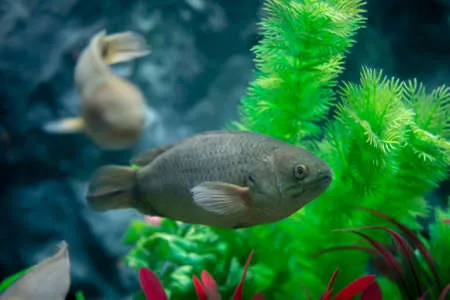
- Scientific Name: Anabas testudineus
- Type: Freshwater Labyrinth Fish
- Habitat: Stagnant waters, ponds, and rice paddies in Southeast Asia
- Diet: Plants, insects, and smaller fish
The Climbing Perch is legendary for its ability to travel across land. Using its sharp, spiny gill plates and strong pectoral fins as “legs,” it can “walk” or crawl from one drying pond to another in search of water.
It is even rumored to be able to climb the low-hanging branches of trees, though this is rare. Because it possesses a “labyrinth organ” (a primitive lung), it can breathe air and survive out of the water for several hours or even days, provided it remains moist.
To understand how a creature designed for swimming can suddenly start walking across a solid surface, we have to look at three distinct biological adaptations:
1. Skeletal Support & “Wrist” Joints
Unlike standard fish whose fins are made of thin, flexible rays, “walking” fish often possess lobe-fins or thickened spines.
- The Bone Factor: Species like the Lungfish and the prehistoric Tiktaalik have a central axis of bone within their fins that mirrors the humerus, radius, and ulna found in human arms.
- Pivot Points: These fish use their fin tips as “contact points.” By locking their fin rays against the substrate, they create a lever system that heaves their body weight forward.
2. The “Crutching” and “Galloping” Motion
Walking fish don’t all move the same way. Their “gait” depends on their environment:
- Crutching: Many bottom-dwellers, like the Handfish, plant their pectoral fins and “swing” their bodies forward, much like a person using crutches.
- Serpentine Pivoting: The Walking Catfish uses its stiff pectoral spines as rigid “stakes.” It plants one spine in the ground and uses a powerful muscular thrash of its tail to pivot its body forward in a rowing motion.
- True Walking: The Frogfish can move its fins independently, allowing it to “step” in an alternating pattern that maintains constant contact with the ocean floor.
3. Neurological Coordination
Perhaps the most incredible mechanic isn’t the bones, but the brain. True walking requires a specific neural circuit called a Central Pattern Generator (CPG).
- In 2018, researchers discovered that some fish, such as the Little Skate, use the exact same genetic “blueprint” and motor neurons that humans use to coordinate left-right limb movement.
- This proves that the “wiring” for walking existed in the nervous system long before animals actually left the ocean.
The presence of “legs” in fish isn’t just a coincidence. It is a living map of evolutionary transition. This journey is defined by three major milestones:
- The Devonian Period: Known as the “Age of Fish,” this era (roughly 375 million years ago) saw species like Tiktaalik develop functional wrists and necks. This allowed them to prop their heads above water to breathe air and scan for land-based food.
- Benthic Specialization: Many modern walking fish, like the Batfish, didn’t evolve legs to leave the water. Instead, they adapted to “walk” because it is more energy-efficient than swimming in high-pressure, deep-sea environments.
- The Survival Crawl: For the Mudskipper and Epaulette Shark, walking is a survival tactic. By “walking” over land or coral reefs, they can escape predators or move between isolated tide pools that other fish cannot reach.
Veterinary Note
The transition from fin to limb required more than just bones. It required a change in the nervous system. Walking fish have developed specialized “motor neurons” in their spinal cords that coordinate left-right limb movement, a trait they share with mammals and birds.
I hope that this list of the top 15 popular fish with legs has fascinated you. All of them have adapted themselves to survive in aquatic or marine habitats and showcase their fascinating characteristics.
Axoloti has brilliant regeneration abilities, while the mudskipper features an amphibious lifestyle. A good thing about the discovery of these fishes is that they have clarified that much more diversified and complex life exists on the Earth, especially beneath the oceans.
Now, the only requirement is to take care of these creatures as some of them are in critical danger.
What type of fish has legs?
While no fish has true mammalian legs, species like the Frogfish, Handfish, and Mudskipper have modified pectoral and pelvic fins with joint-like structures that allow them to walk, crawl, or gallop on the seafloor or land.
Which fish have 8 legs?
The Octopus is the most famous 8-armed aquatic creature. However, biologically, an octopus is a mollusk (cephalopod), not a fish. In the fish world, the Sea Robin is unique for having 6 leg-like rays used for walking and tasting the sand.
What starfish has 7 legs?
The Seven-armed Starfish (Luidia ciliaris) is a large echinoderm known for having seven long, fragile arms used for rapid movement across the seafloor.
What fish has four legs?
The Axolotl is widely called the “Mexican Walking Fish” due to its 4 legs (limbs), though biologically it is a neotenic salamander (an amphibian), not a true fish.
Is the Axolotl a fish?
No, the Axolotl is a neotenic salamander (an amphibian). It is often called the “Mexican Walking Fish” because it retains its aquatic larval features, such as external gills, while possessing four fully functional legs.
What is the most famous “fossil fish with legs?”
Tiktaalik is the most famous prehistoric “fishapod.” This extinct lobe-finned fish lived 375 million years ago and represents the evolutionary transition from water-dwelling fish to four-legged land animals (tetrapods).
