

Many bird owners and farmers ask me how long crows live, especially when they frequently see the same birds around their homes. I also have always been fascinated by crows. Every morning when I walk toward the clinic, I notice the same pair of crows waiting on the corner of the rooftop.
Their intelligence shows in the way they observe people and how they seem to remember faces. Understanding a crow’s lifespan helps us appreciate their intelligence even more. So now, we will have a look at how long crows live in the wild and in captivity, what factors affect their survival, and what makes these birds so extraordinary.
| Crow Type / Species | Lifespan in the Wild | Lifespan in Captivity | Notes |
|---|---|---|---|
| American Crow (Corvus brachyrhynchos) | Seven to ten years on average | Up to twenty to thirty years | One of the most common crow species in North America |
| Carrion Crow (Corvus corone) | Seven to nine years | Up to twenty years or more | Strong adaptability to farmland and urban environments |
| Hooded Crow (Corvus cornix) | Six to eight years | Fifteen to twenty years | Common in Europe and parts of the Middle East |
| Rook (Corvus frugilegus) | Five to eight years | Fifteen to eighteen years | Lives in large colonies and prefers open farmland |
| Jungle Crow (Corvus macrorhynchos) | Seven to ten years | Up to twenty five years | Highly adaptable to human environments across Asia |
| Raven (Corvus corax) | Ten to fifteen years | Up to forty years or more | Largest member of the crow family, extremely intelligent |
Crows generally live 7 to 10 years in the wild and more than 20 years in captivity.
Many people assume that crows live only a few years because they frequently interact with humans and seem to constantly face environmental challenges. The reality is quite surprising.
Crows live longer than most wild birds, and if given proper care in captivity, they can live even longer. I have explained both the natural life expectancy and the potential for crows to reach old age in protected environments.
a) Crow Lifespan in the Wild
In the wild environment, crows face predators, diseases, and harsh weather. Still, they manage to live longer than many other birds of similar size. The average life expectancy of a wild crow is 7 to 10 years.
Some individuals can reach 15 years if environmental conditions are supportive. This extended lifespan is possible because crows are highly intelligent, cooperative within their groups, and excellent at finding food.
They learn from older birds, adapt quickly, and use problem solving skills to avoid danger.
b) Crow Lifespan in Captivity
Captive crows can live significantly longer because they do not need to worry about predators or extreme conditions. In controlled environments such as wildlife sanctuaries, crows often reach 20 to 30 years of age.
There are documented cases of crows living up to 40 years under human care. When they have consistent access to balanced nutrition, veterinary care, and mental stimulation, their lifespan expands.
Captive crows rely on enrichment such as puzzle feeders and social interaction to prevent behavioral problems caused by boredom.
Just like any animal, a crow’s lifespan depends on multiple environmental and biological factors. So, I am going to highlight how habitat quality, diet, disease exposure, predators, and even human activities influence how long they live.
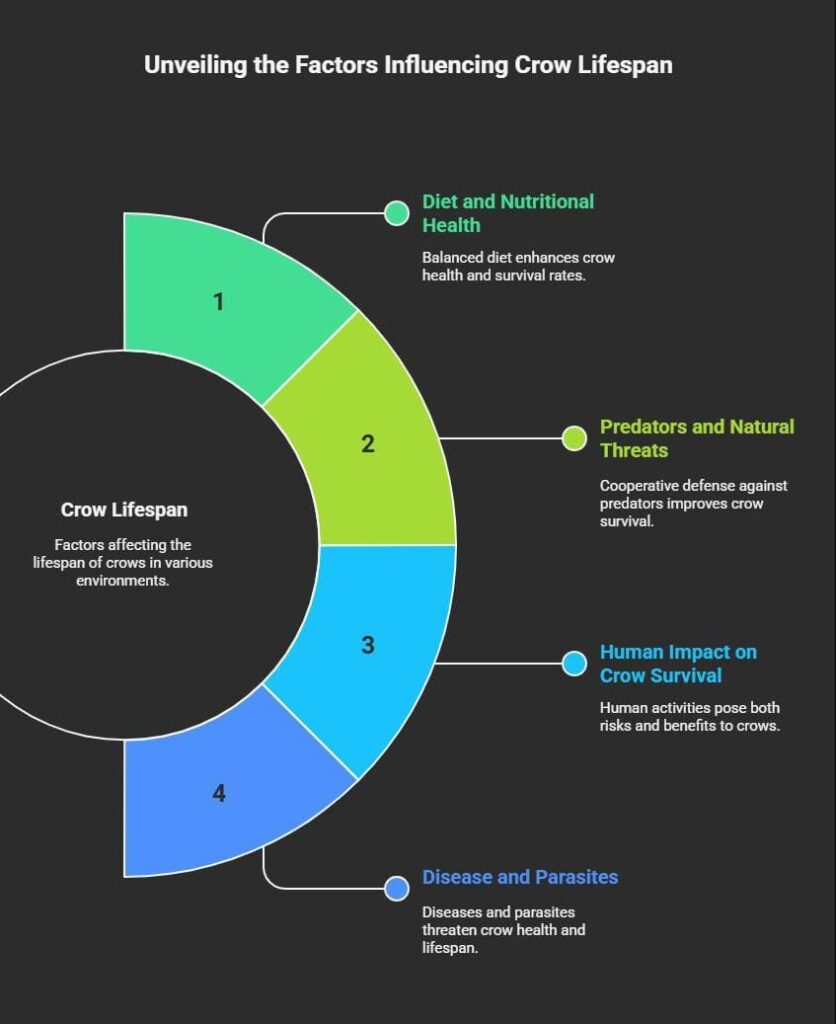
Understanding these factors helps us appreciate why crows in captivity live longer than those in the wild.
1. Diet and Nutritional Health
Crows are opportunistic omnivores. Their ability to eat a wide range of food sources increases their survival rate. Yet many crows living close to humans consume leftover fast food and processed foods from bins.
Although it provides quick calories, it does not provide balanced nutrition. In natural settings, crows eat fruits, seeds, insects, small rodents, eggs, and even carrion. A nutritionally rich diet improves their immune system and keeps their feathers healthy.
In captivity, a balanced diet that includes fruits, vegetables, whole protein sources, and supplements allows them to live much longer.
2. Predators and Natural Threats
Even though crows are intelligent, they still encounter danger from predators. Larger birds like eagles, owls, and hawks may hunt them. On the ground, wild cats, foxes, and snakes can pose a threat, especially for young crows that cannot fly well yet.
Crows protect themselves by living in cooperative groups. They warn each other when predators appear and sometimes mob intruders by dive bombing from multiple directions. This teamwork reduces risk but does not eliminate it completely.
3. Human Impact on Crow Survival
Human activities affect crow survival both negatively and positively. Urban environments give crows abundant food sources. On the other hand, cars, power lines, intentional poisoning, and habitat destruction increase mortality.
Many crows are injured or killed by vehicles. Additionally, human garbage leads to nutritional imbalances because processed food lacks essential vitamins and minerals. Despite these risks, crows adapt quickly.
They learn traffic patterns and use cars to crack nuts by dropping them onto roads, then retrieving the pieces once the signal stops traffic.
4. Disease and Parasites
Like any wildlife species, crows face risk from diseases and parasites. West Nile virus is one of the most serious threats. It spreads through mosquitoes and affects the nervous system. Many crow populations experienced sudden declines when the West Nile virus appeared in various regions.
Internal parasites and external parasites like mites also reduce feather quality and weaken their immune response. In captivity, veterinary care prevents most of these problems before they progress into life-threatening conditions.
Crows are considered one of the most intelligent bird species in the world. Their intelligence plays a major role in their survival and contributes to their longer lifespan compared to other birds.
So, how do crows use learning, memory, and cooperation to prolong their lives? Let’s get into it:
a) Problem Solving Skills
Crows use comprehensive thinking to survive. They make tools out of sticks to extract insects from logs. They drop hard nuts on roads so passing vehicles can crack them open. Crows also understand cause and effect.
I once observed a crow sliding pieces of bread into flowing water near my clinic. It quickly returned to catch small fish attracted by the bread. These strategies show that crows actively experiment and learn through trial and error.
b) Facial Recognition and Memory
Crows remember human faces. If a person harms a crow, the bird will remember that face for years. Not only does the crow remember, but it also communicates this information to other crows.
Studies show that groups of crows warn each other when a recognized dangerous person appears. This memory based defense system allows them to avoid threats and live longer.
To understand lifespan better, we should explore how crows grow, mature, form social groups, and reproduce. The life cycle reveals why strong family structures help them survive longer.
1. Nesting and Early Development
Crow parents are excellent caregivers. A breeding pair selects a nest site in tall trees or secure elevated structures. They line the nest with soft material and produce a comfortable environment for the eggs.
Chicks hatch blind and helpless. Both parents and sometimes older offspring from previous years contribute to feeding and protecting new chicks. This cooperative system increases survival rates.
2. Juvenile Stage and Learning
As young crows grow, they begin exploring and learning crucial survival skills. They observe adults to learn how to locate food, avoid predators, and communicate with vocalizations.
Juvenile crows rely on family support even after they can fly. This extended learning phase increases their chance of survival.
3. Adult Maturity and Group Living
Adult crows remain connected to their family group. They roost together, especially during winter. Crows also perform sentinel behaviors where one crow watches for danger while others eat.
This shared responsibility allows individuals to stay safe and reduce stress, which contributes to a longer lifespan.
Humans and crows share space in cities, farms, and rural environments. Some people enjoy feeding crows. Others see them as pests. I have discussed how interactions with humans can shape a crow’s lifespan.

1. Crows as Pets
Owning a crow is illegal in many countries without special permits because crows are classified as protected wildlife. They require advanced care and constant mental stimulation. In captivity, crows bond deeply with their caretakers but can also develop aggressive behavior if bored. They are not suitable as casual pets.
2. Crows on Farms
Farmers often feel frustrated when crows take seeds or disturb freshly planted fields. However, crows also control pests by eating insects and rodents. I always recommend farmers to observe the balance because crows may actually benefit crop health when allowed to coexist peacefully.
3. Feeding Crows Near Homes
People who feed crows can unintentionally create dependence. Feeding them processed foods reduces nutritional balance. Instead, offer natural foods such as fruits and unsalted nuts if you want to interact with them responsibly. The goal should be to supplement, not replace, their natural foraging behavior.
Crow populations are stable in many areas, but in regions affected by disease or habitat loss, supporting their survival becomes important. Here I have listed some practical steps to improve crow safety in human dominated spaces.
- Create Safe Feeding Areas: If you choose to feed crows, do it responsibly. Avoid processed food and always place food in safe areas away from roads. Encouraging a natural diet improves immune strength, which helps them live longer.
- Reduce Risks in Urban Areas: Simple adjustments reduce crow mortality. Securing garbage prevents ingestion of harmful waste. Installing reflective markers on windows reduces collision deaths. Restricting chemical use on lawns prevents poisoning.
- Support Wildlife Organizations: Many wildlife rehabilitation centers care for injured crows. Donations and volunteering help these centers provide long term care. Supporting local conservation projects also increases community awareness.
Crows live longer than most people expect. In the wild, crows typically live 7 to 10 years because of predators, disease, and environmental challenges. In captivity, with proper nutrition and veterinary attention, they can live up to 30 years or even 40 years.
Their intelligence, memory, tool use, and strong family bonds allow them to adapt and survive in diverse environments. Understanding their lifespan and behavior encourages us to respect these remarkable birds.
If you observe crows near your home or farm, remember that they are not just noisy black birds. They are intelligent creatures that contribute to the ecosystem. Appreciating their presence enriches our environment and keeps nature in balance.
